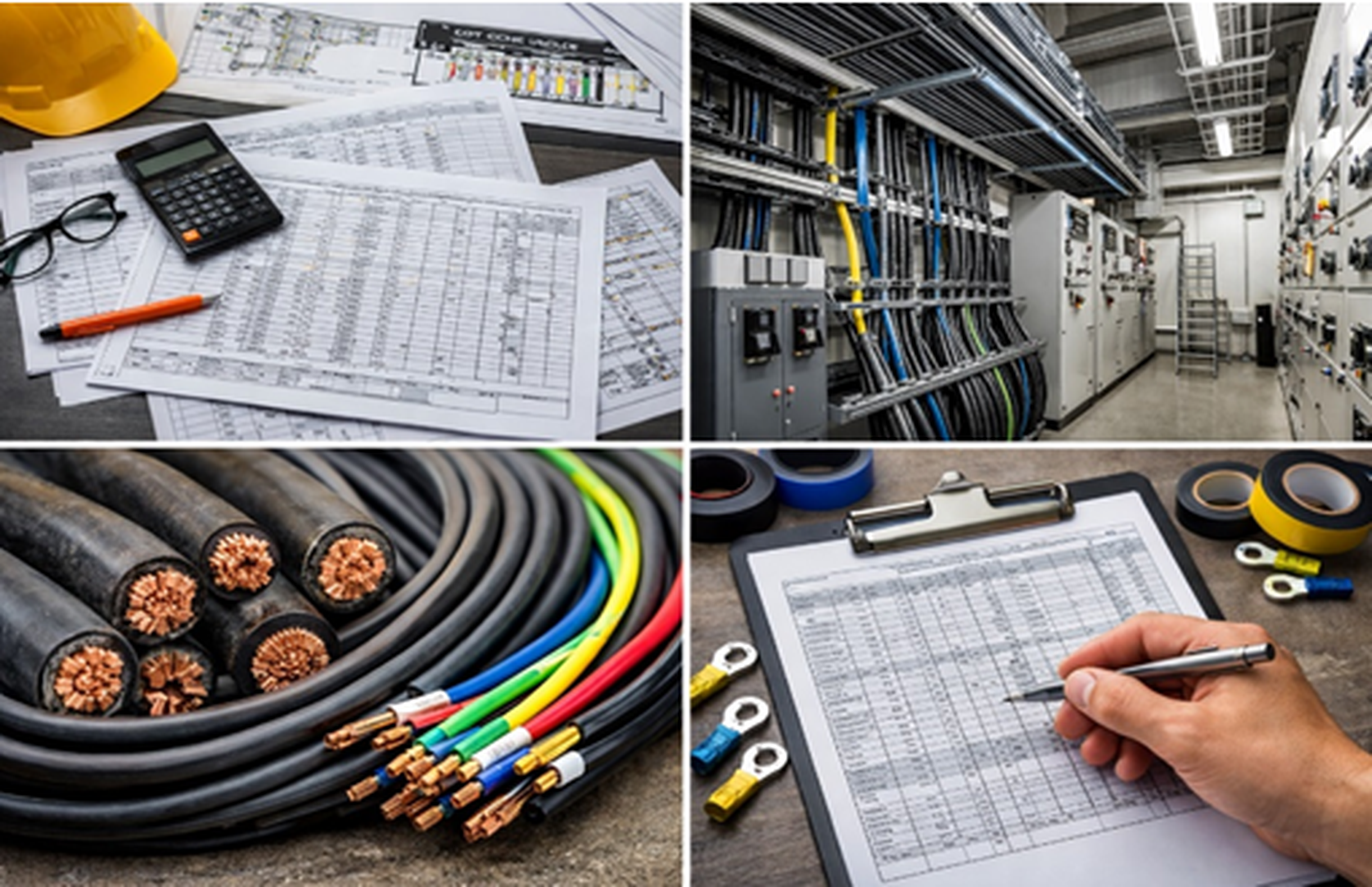
The Unsung Heroes of Reliability
Introduction
In modern power systems, cables are the lifelines that carry electricity and signals across substations, switchyards, and industrial plants. Yet, without proper organization, they can quickly become a source of inefficiency, safety hazards, and maintenance nightmares. This is where cable managers step in — the silent guardians ensuring order, safety, and compliance.
What
• A cable manager is a structured system or device used to organize, route, and secure power cables in substations, switchyards, and industrial plants.
• It ensures cables are laid out systematically to avoid tangling, mechanical stress, and electrical hazards.
Why
• To maintain safety and reliability in power systems.
• Prevents overheating, mechanical damage, and accidental disconnections.
• Enhances inspection, maintenance, and compliance with IS/IEC standards.
• Reduces downtime and improves operational efficiency.
Where
• Installed in substations, control rooms, switchyards, hydro/industrial plants, and along cable trays or trenches.
• Used wherever multiple power/control cables need structured routing and segregation.
How
• By using trays, ducts, clamps, and protective covers to guide cables.
• Ensures proper spacing, bending radius, and segregation of power, control, and communication cables.
• Implements labelling, documentation, and standardized layouts for easy identification and maintenance.
A look back:
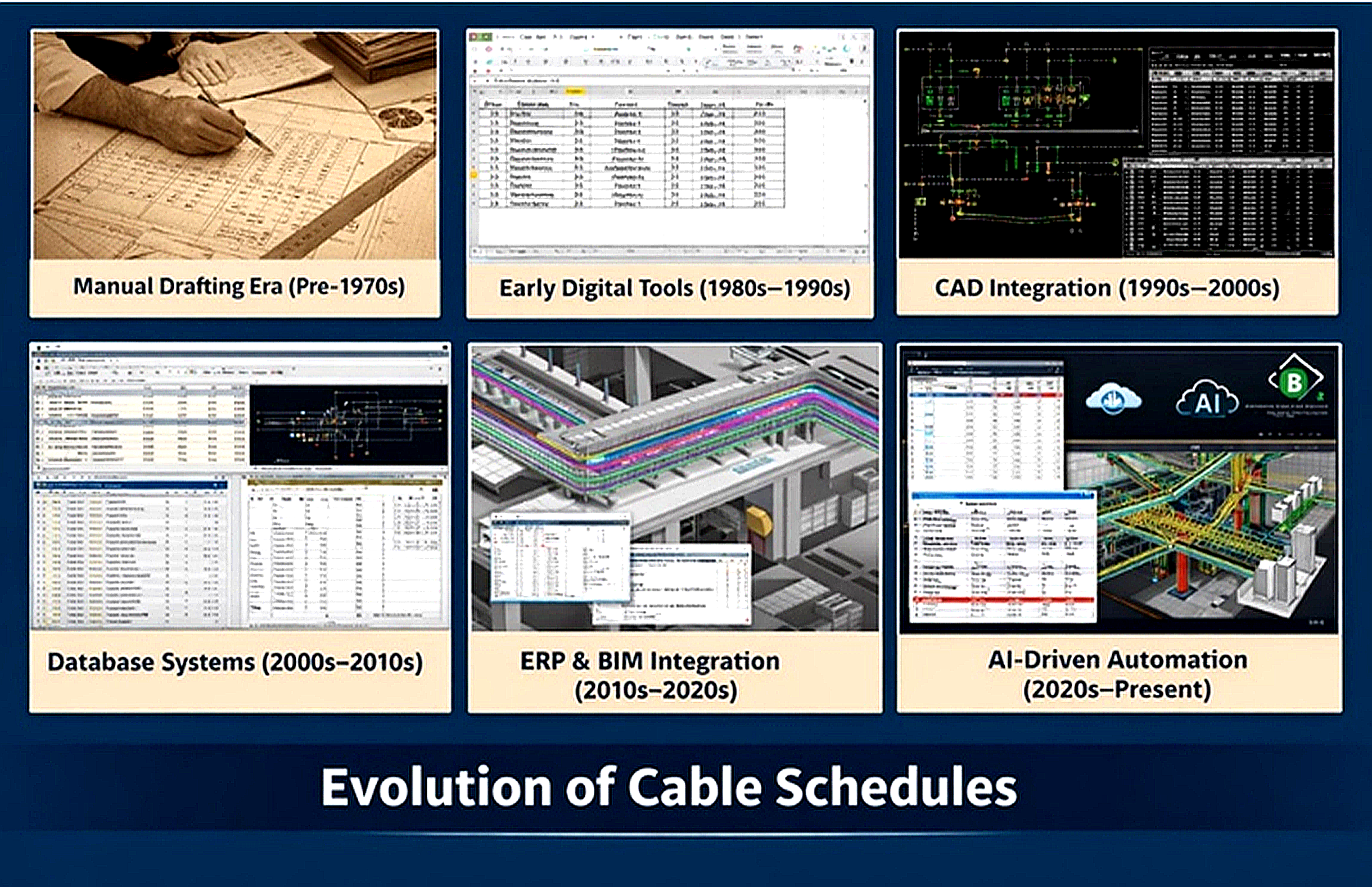
Cable Schedule documentation has evolved across generations in engineering practice. This is a fascinating journey because it reflects both technological progress and the increasing complexity of projects.
1. Manual Drafting Era (Pre-1970s):
• Cable schedules were handwritten or typed in tabular form.
• Engineers relied on physical ledgers and blueprint drawings.
• Errors were common due to manual cross-referencing between drawings and schedules.
• Updates required redrawing entire sheets.
2. Early Digital Tools (1980s–1990s)
• Introduction of spreadsheets (Lotus 1-2-3, later MS Excel).
• Cable schedules became structured tables with fields like cable number, source, destination, length, and type.
• Easier to update and replicate, but still prone to human error.
• No integration with CAD drawings — schedules and layouts were separate.
3. CAD Integration (1990s–2000s)
• AutoCAD and similar platforms allowed linking cable schedules with schematic drawings.
• Engineers could generate cable tags and routing diagrams semi-automatically.
• Reduced duplication of effort, but required skilled CAD operators.
• Documentation began to align with IEC/ANSI/IS standards more consistently.
4. Database-Driven Systems (2000s–2010s)
• Specialized software (e.g., EPLAN, Smart Plant) introduced.
• Cable schedules stored in relational databases with attributes like voltage class, insulation, tray routing, and termination details.
• Automatic report generation ensured consistency across drawings, schedules, and BOMs.
• Enabled vendor evaluation and procurement integration.
5. ERP & BIM Integration (2010s–2020s)
• Cable schedules linked with ERP systems (SAP, Oracle) for procurement and cost tracking.
• BIM (Building Information Modeling, Revit) allowed 3D visualization of cable routing.
• Real-time clash detection and routing optimization.
• Documentation became part of a larger digital twin of the project.
6. AI-Driven Automation (2020s–Present)
• Specialized AI Software (PC Schematics) generate cable schedules directly from schematic inputs.
• Predictive algorithms suggest optimal cable sizing, routing, and tray allocation.
• Integration with procurement platforms standardizes vendor comparison and pricing.
• Cloud-based collaboration ensures multiple teams can update schedules simultaneously.
• Compliance checks against IEC/ANSI/ IS standards are automated.
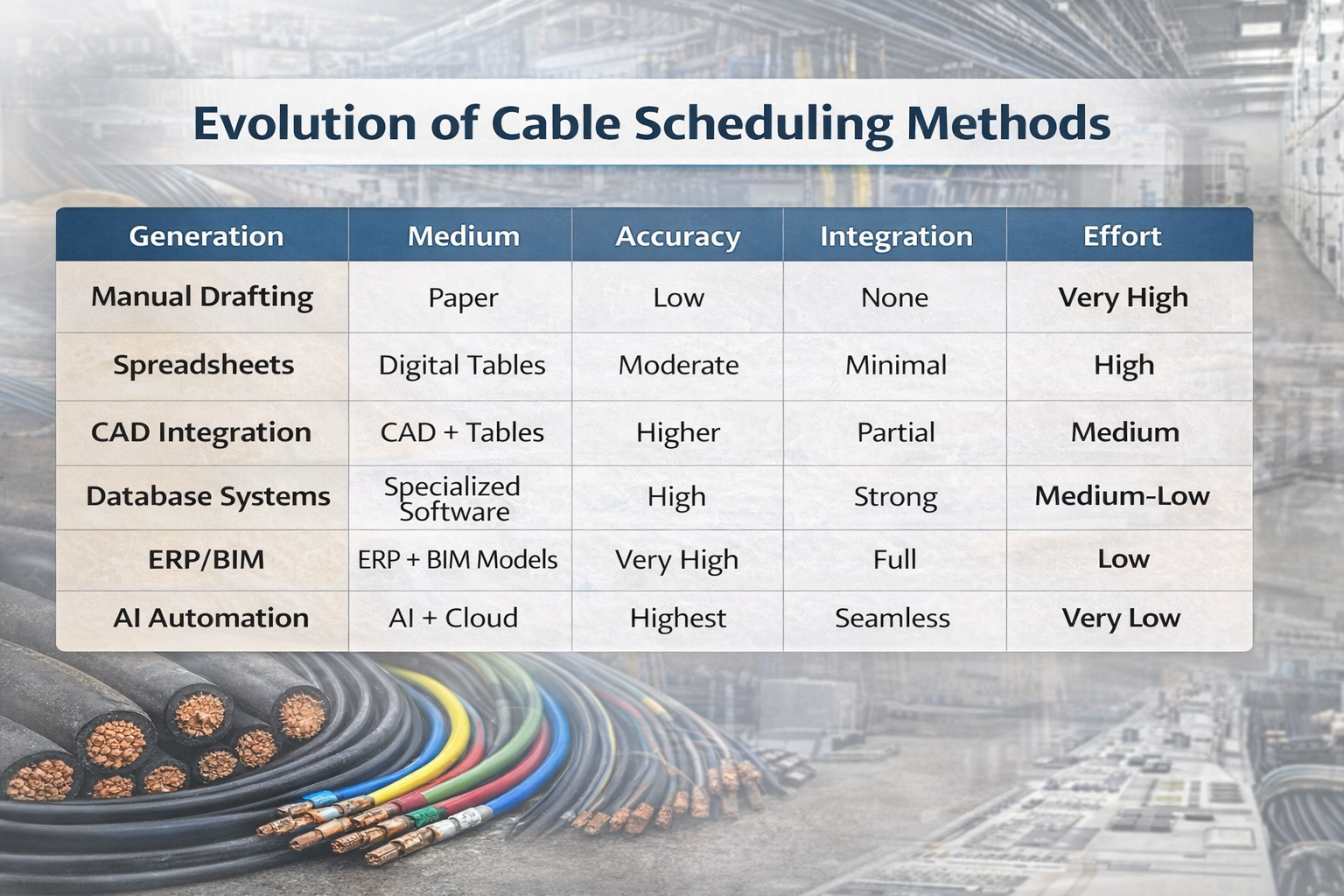
Evolution of Cable Scheduling: From Manual Drafting to AI-Driven Automation
The table below illustrates the progressive transformation of cable scheduling methods from traditional manual practices to advanced AI-driven systems. Initially, cable scheduling relied on manual drafting using paper, which was highly labor-intensive, prone to errors, and lacked any form of integration. With the introduction of spreadsheets, the process became digital, offering moderate accuracy but still limited integration and requiring significant effort.
The evolution continued with CAD integration, which improved accuracy and enabled partial system connectivity, reducing manual workload. Database systems further enhanced efficiency by providing structured data management, higher accuracy, and stronger integration capabilities. The adoption of ERP and BIM technologies marked a major advancement, enabling full integration across systems, very high accuracy, and significantly reduced effort.
In recent years, AI-driven automation has revolutionized cable scheduling by combining artificial intelligence with cloud technologies. This approach delivers the highest level of accuracy, seamless integration, and minimal human effort. Overall, the progression highlights a clear shift toward automation, improved precision, and enhanced system connectivity, making modern cable scheduling faster, smarter, and more efficient.
Key Shifts Over Generations
The biggest leap has been from static documentation to dynamic, integrated systems where cable schedules are no longer just records but active tools for design, procurement, and project management.
AI-enabled cloud-integrated cable scheduling achieves maximum accuracy, end-to-end interoperability, and minimal computational and human effort. – Compiled by Bistable Control Solutions
Disclaimer
"This document is intended for technical reference only. Users are advised to
verify all design parameters, standards, and specifications independently before
implementation in any project environment."